The children have really enjoyed learning about plant growth through growing strawberries in the classroom. They explored the science behind how plants grow — discovering the importance of water, nutrients, and sunlight, as well as learning about pollination and seed dispersal. Watching the strawberries develop from flowers to fruit was a wonderful hands-on learning experience, made even better by finally getting to taste and enjoy the strawberries they helped to grow.
Category Archives: Science
The Life Cycle of the Frog
The children in the Junior Room are currently exploring the life cycle of a frog, and it has been a truly engaging experience. They have been fascinated by watching tadpoles hatch from frog spawn and begin their journey of growth into adult frogs (under licence).
Starting as eggs laid in clusters known as spawn, the frogs develop into tadpoles before undergoing metamorphosis—the remarkable transformation from aquatic tadpoles into young frogs. By keeping frog spawn in glass tanks in the classroom, the children have a valuable opportunity to closely observe each stage of this life cycle and deepen their understanding through hands-on learning.
Lifetime Lab
Exploring Reaction Time with Chuck Delpier
During the evening session of our Science Adventures workshop, Chuck Delpier led the children through two exciting activities that explored reaction time, coordination and how quickly the brain and body can work together.
The first challenge involved catching pieces of PVC piping as they dropped down a stick. Larger pieces were easier to catch, but the smaller they became the quicker the children had to react. This activity helped the children see how reaction time works — their eyes had to spot the falling piece, their brain had to process what was happening, and their hands had to respond almost instantly. It was a fun way to experience the pathway from stimulus to response.
The second activity was full of energy and laughter. The children had to collect as many balls as possible and place them in a bucket, all while keeping a balloon in the air. This required them to divide their attention, make quick decisions and coordinate their movements carefully. They soon discovered how challenging it is to manage two tasks at once and how the brain constantly shifts focus to keep everything under control.
Both activities were lively, engaging, and wonderfully hands-on. Chuck’s workshop once again showed how science can be active, playful and packed with learning. The children had a fantastic time testing their reactions, improving their coordination and discovering how amazing the human brain really is.
Exploring Chemistry at Our Science Adventures Workshop
As part of our recent Science Adventures workshop with Chuck Delpier, the children took part in a series of exciting hands-on chemistry activities. Chuck workshops are always a favourite, filled with curiosity, colour and discovery.
One of the first activities explored surface tension. The children sprinkled sawdust onto water and watched how it floated on the surface. When a single drop of soap was added, the sawdust suddenly scattered across the container. This happened because soap acts as a surfactant, reducing the water’s surface tension and causing the floating sawdust to move away quickly. It was a simple but striking way to see how soap affects water.
The children then investigated surface tension further by seeing how many droplets of water they could place on a coin. Using a dropper, they added water slowly and were amazed to see a raised dome form on top of the coin. With magnifying glasses, they could observe how the strong attraction between water molecules allowed the droplet to grow higher than the edge of the coin before finally spilling over.
Another favourite activity involved exploring pH using red cabbage water. Red cabbage contains natural pigments that change colour depending on acidity. The children added vinegar, which turned the indicator a pinkish-red, and then baking soda solution, which produced greens and blues. These dramatic colour changes helped them understand acids, bases and how indicators work.
The children also created their own mini “lava lamps.” A container was filled with oil and water coloured with red food dye. When an Alka-Seltzer tablet was dropped in, the children watched as bubbles of gas carried the coloured water upward through the oil before falling back down again. This demonstrated how oil and water don’t mix, how density affects movement, and how chemical reactions can produce gases that create motion.
These activities gave the children a fun and memorable introduction to chemistry, showing them how everyday materials can reveal fascinating scientific ideas. Chuck’s workshop, as always, was engaging, colourful and full of hands-on learning that the children absolutely loved.


Exploring Physics at Our Science Adventures Workshop
As part of a Science Adventures workshop led by Chuck Delpier, the children took part in a series of hands-on physics activities. Chuck has visited our school many times, and his workshops are always a highlight for the children, who love the fun, interactive approach he brings to science.
One of the activities explored balance and structural engineering. Using six sticks and six small columns, the children created an interlocking structure similar to a mini roof. They discovered that when the sticks supported one another, the structure became strong enough to hold weight. This simple exercise helped them understand how forces can be balanced and distributed, and how smart design keeps real buildings and bridges stable.
A second activity introduced the idea of centripetal force. The children used large slings containing bean bags and swung them around in circles at speed. They learned that the bean bags moved in a circular path because the sling provided a force pulling them toward the center, which prevented them from flying off in a straight line. It was an exciting way to see circular motion in action.
These activities gave the children a lively and practical introduction to physics, showing how balance, motion and force play a role in everyday life. As always, Chuck’s workshop was full of energy, curiosity and hands-on learning — an experience the children thoroughly enjoyed.
Science Week 2025
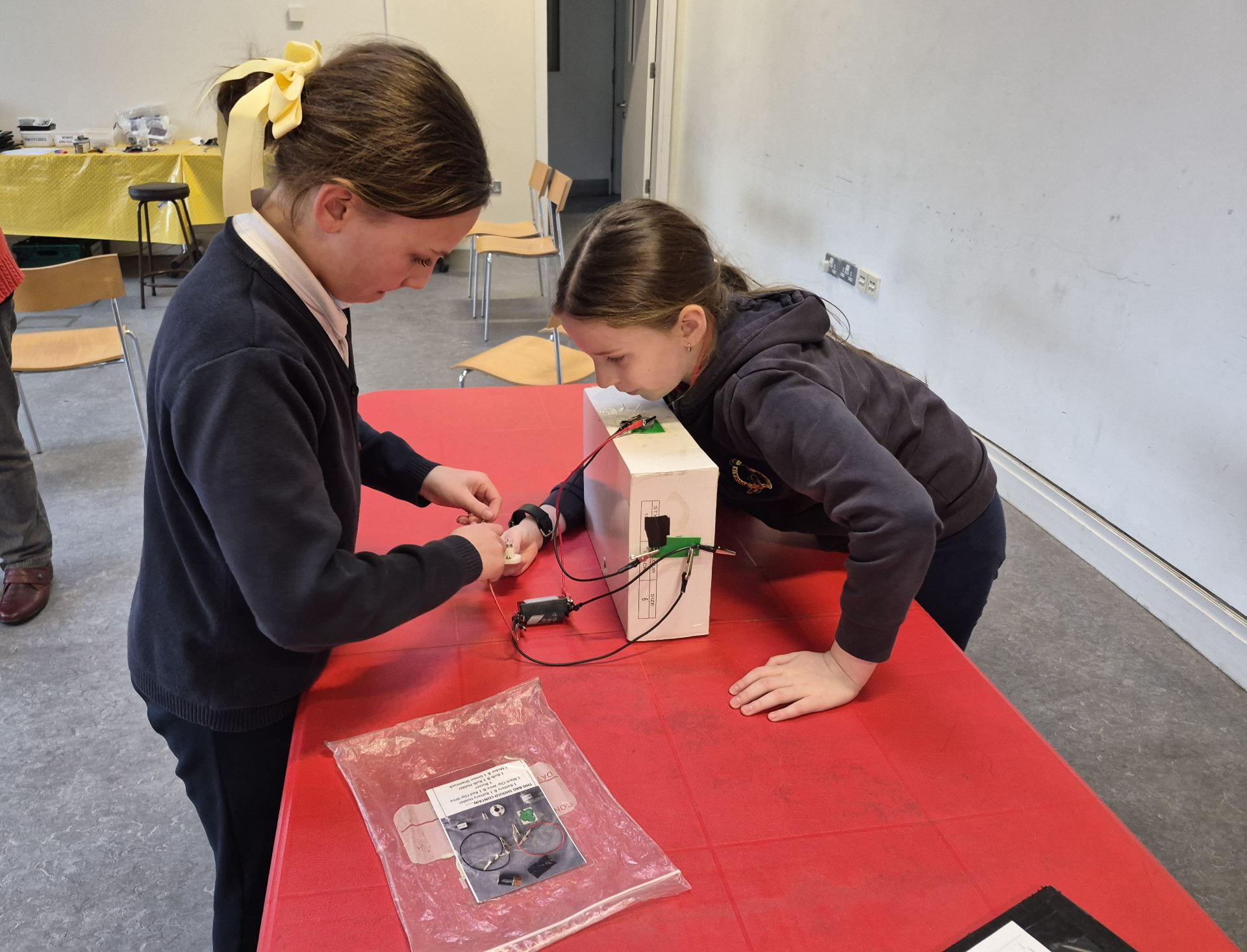
As part of Science Week 2025, the children in the Senior Room proudly presented a wonderful variety of individual science experiments to their classmates—and to the very excited visitors from the Junior Room.
Each pupil chose their own investigation to demonstrate, turning the classroom into a lively science fair filled with colour and curiosity. Some highlights included Walking Water, the strange and squishy world of Oobleck, the explosive fun of Elephant Toothpaste, and the ever-popular Volcanic eruption. There was also a display of Fizzy Colours, a spinning demonstration of Centripetal Force, the colourful swirl of Rainbow Skittles, bubbling Vinegar and Baking Soda reactions, and a sparkling mixture of glitter, water, and soap.
The Senior Room children explained their experiments with confidence and enthusiasm, while the Junior Room pupils listened eagerly, asked some wonderful questions, and joined in the excitement. It was a fantastic celebration of creativity, learning, and hands-on discovery—well done to all our young scientists.
Walking Water Experiment
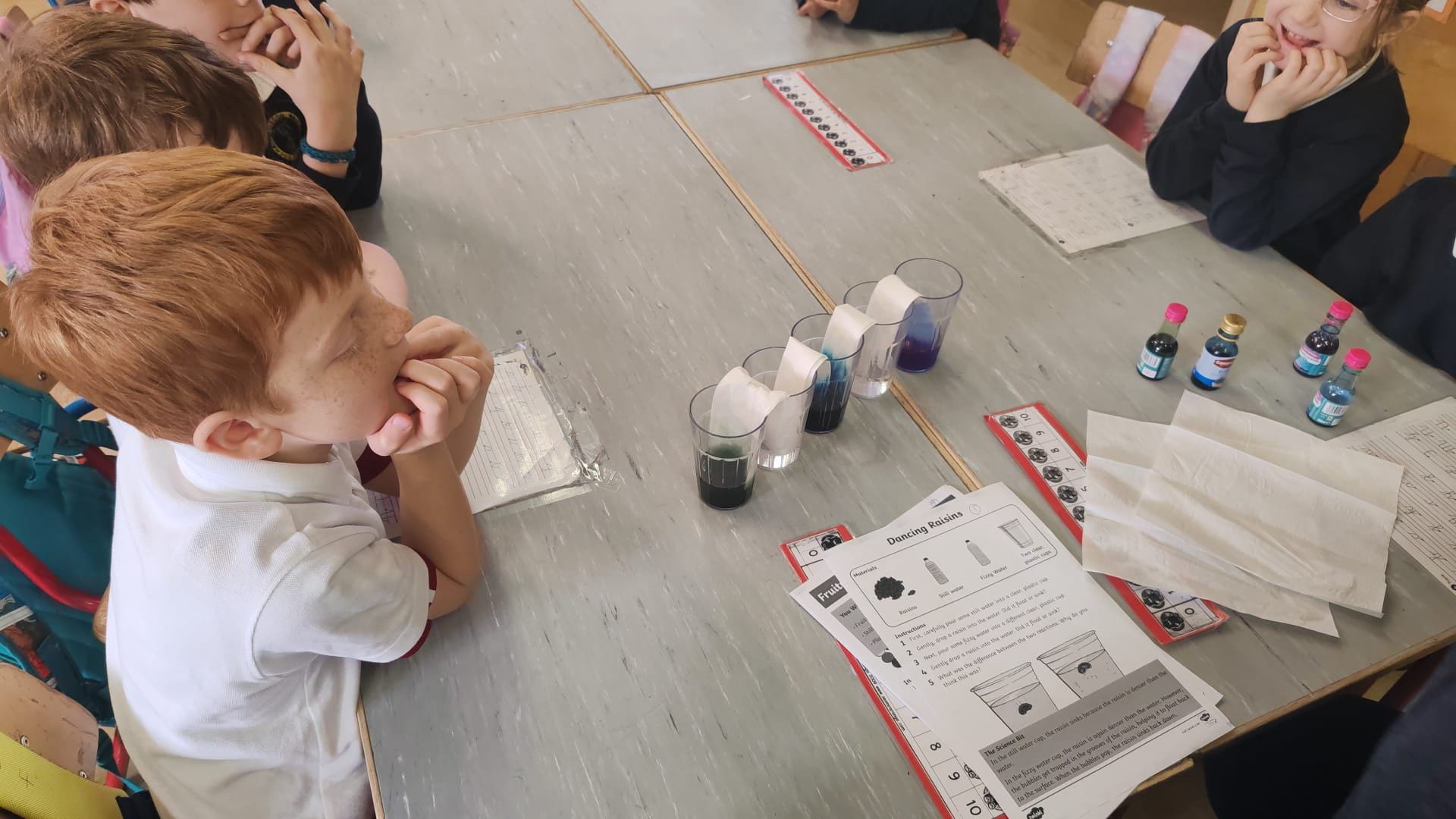
During Science Week, the Junior Room took part in the Walking Water Experiment. The children arranged a line of glasses on the table, filling every second glass with different coloured water. Then folded paper towels were placed between each cup to act as bridges.
Before long, the children noticed the colours beginning to “walk” along the paper towels. Slowly, the coloured water travelled from one glass to the next, creating new colours as it mixed.
Throughout the experiment, the class observed how absorption works and how water can move even without being poured. They enjoyed making predictions and watching the colours meet and mix in the empty glasses.
Rainbow in a Glass
Science Week in the Senior Room was bursting with colour… literally. This week, our class explored how different liquids can form a rainbow in a glass using just honey, baby oil, water, and food colouring.
We began by mixing food colouring with different liguids to create solutions of varying density. Then with very steady hands, we carefully layered each coloured liquid into a tall glass slowly forming a bright, beautiful rainbow of colours.
The experiment taught us how density works and why heavier liquids stay at the bottom while lighter ones float on top. The class had great fun and learned something new – Science Week success.
Science Week – Raisins can Dance
The children in Miss Daly’s class had a fantastic time during Science Week discovering the magic of buoyancy with the “Dancing Raisins” experiment.
Here’s the quick science: When raisins are dropped into a fizzy drink, they sink. But then, carbon dioxide bubbles stick to them, acting like tiny balloons that carry the raisins to the surface. Once the bubbles pop at the top, the raisins sink back down, creating a fun, dancing effect until the soda goes flat. It was a fun yet powerful lesson that the children really enjoyed.